January 20, 2026
Opening Celebration: January 20, 4pm Ebert Art Center
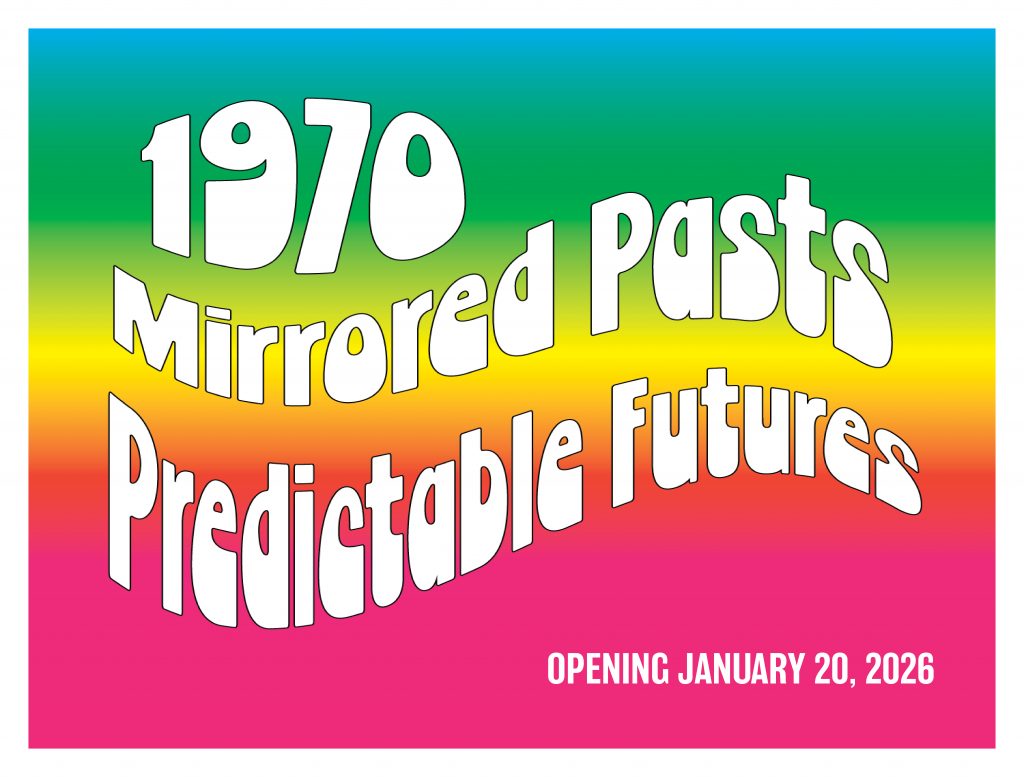
1970 marked a cultural shift at the end of a decade of growing cynicism and anxiety. This exhibition presents work produced in that year as artists visibly responded to the progress and anxieties of the era. Many worked as commercial graphic designers, creating advertisements and product packaging while also sustaining an artistic practice. Some focused on the portrayal, documentation, and expression of emotions and feelings through abstraction. Others drew on popular mass culture, reproducing and critiquing it simultaneously.
The positivity that came along with an economic boom following World War II in the US and Great Britain began to dissipate through the 1960s. Global conflict persisted, and the world found itself gripped by a Cold War stalemate between the Soviet Union and the United States.
Immense technological advances provoked a space race, and art and design reflect an enthusiasm for “the atomic age.” Rising global mass media inundated the populace with colorful, punchy advertising aimed at selling new products and conveniences made possible by industrial innovations. At the same time, concerns grew about scientific innovation without guardrails or morality to guide it, as the threat of nuclear annihilation and ecological destruction loomed.
Disillusionment about the progress of civil rights, skepticism toward foreign wars, growing awareness of damage to the environment, increasing political violence, and rising economic inflation triggered a mounting suspicion towards foundational institutions. People rose up in strikes and protests against war, labor conditions, environmental destruction, and civil rights—particularly for Black and Native American liberation. In the face of growing pessimism we also see great resilience and social consciousness.
In many ways we see the experiences of 1970 mirrored in the current events and mood of our day. Looking back at the art of 1970 within the context of 2026, we ask whether our current reality was a predictable future, or whether we might learn the lessons of the past as we work to create a new and better world.
This exhibition was curated by College of Wooster students Jack Ferrell ’28, Roman Mackenzie ’28, Riley Polomoscanik ’28, Iris Roth-Bamberg ’26, and Jacob Sabes ’28, assisted by Marianne Eileen Wardle, Director/Curator. Many thanks to Doug McGlumphy, Preparator, for exhibition design and installation, and Tracy Mathys, Administrative Coordinator, for program support and design for promotional materials.
This exhibition and programs are made possible by the generous support of the Julia Shoolroy Halloran Endowed Fund.
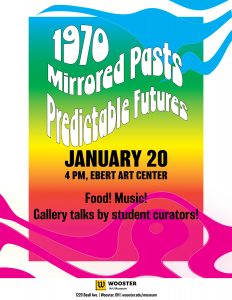
Opening Celebration!
Tuesday, January 20, 2026
4pm
Ebert Art Center
Be groovy and join us for the opening of our spring show with gallery talks from student curators and period-appropriate refreshments and music!
I Heart Art!
Friday, February, 2026
4 – 6 pm
Ebert Art Center
Come celebrate love in all its forms with us at the CW Art Museum!
Drop in from to view the galleries at your own pace, get creative with craft supplies, or write a love note to yourself or a friend.

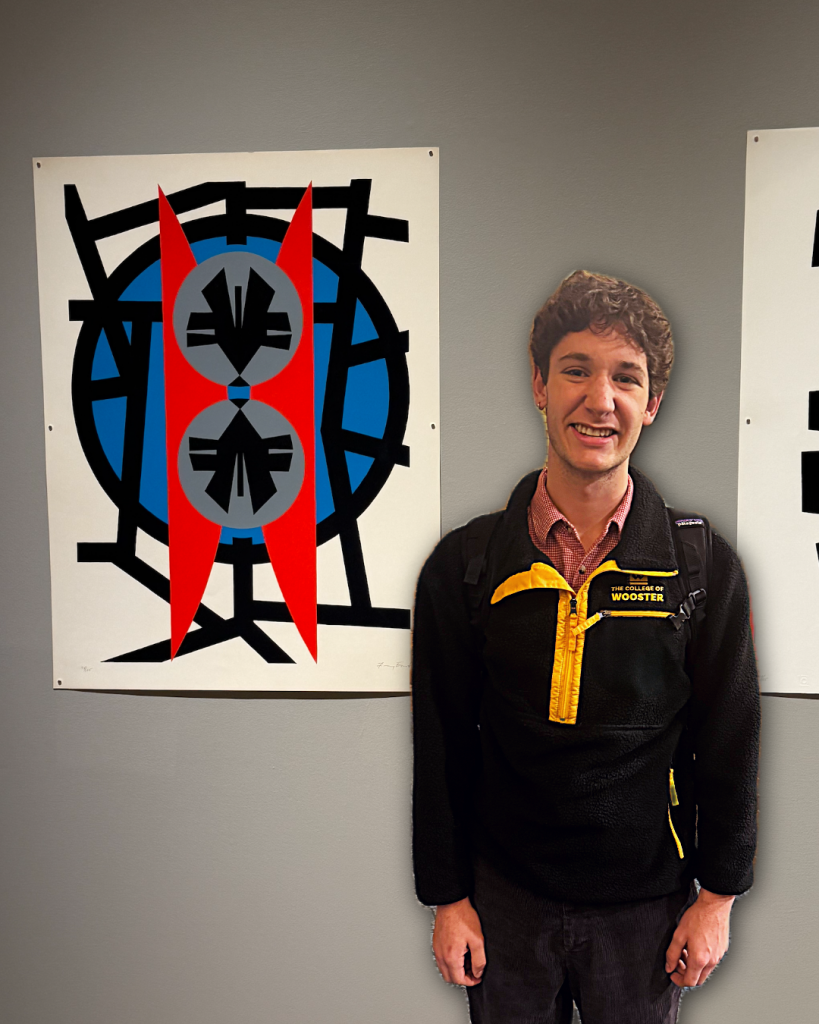
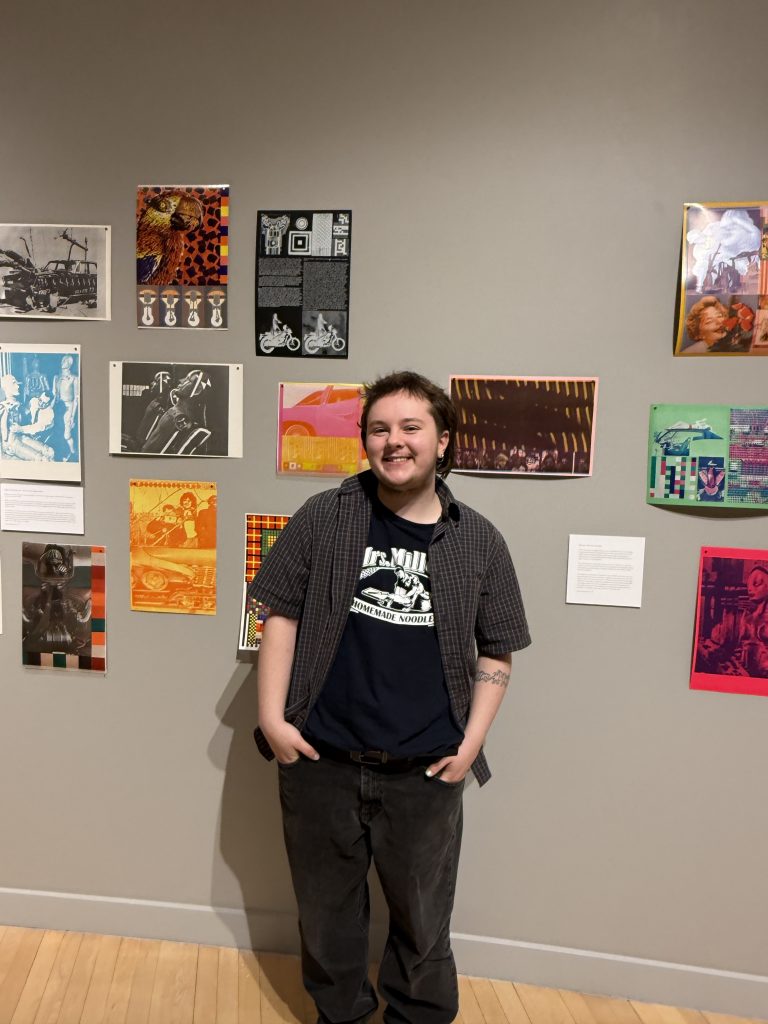
Jackson Forrest Ferrell
Graduation Year: 2028
Major/Minor/Pathway: Art History
Favorite Color: Brown
Favorite piece currently on view: General Dynamic Fun by Paolozzi
Something that surprised you about 1970: I recently got a new pair of shoes for Christmas and my grandmother, who graduated from college in 1969, commented that she had the same pair when she was my age. Fashion is cyclical, and we may be wearing many of the same things that these artists were wearing when they made these pieces.
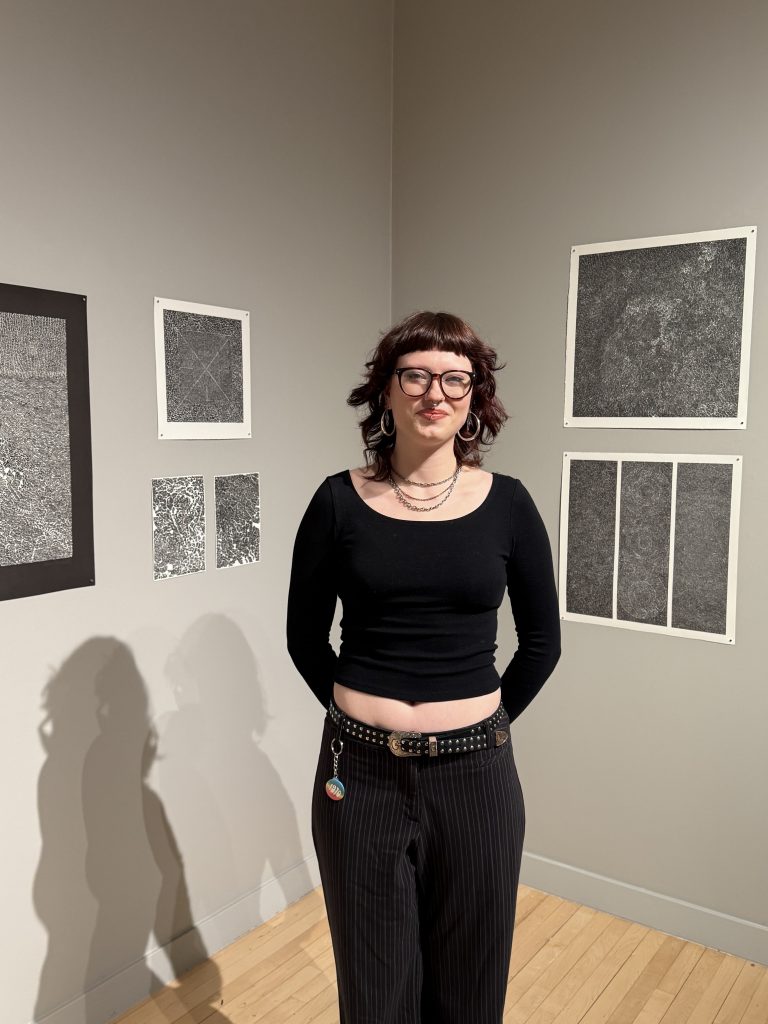
Iris Roth-Bamberg
Graduation Year: 2026
Major/Minor/Pathway: Sociology major, art history minor, and museum + archival studies pathway
Favorite Color: Burgundy
Favorite piece currently on view: Hospital by Nicholas Monro
Something that surprised you about 1970: I had no idea about futureshock before this class.
Roman Mackenzie
Graduation Year: 2028
Major/Minor/Pathway: Art History/WGSS Double Major
Favorite Color: Green
Favorite piece currently on view: Risk Taking as a Function of the Situation by Paolozzi
Something that surprised you about 1970: I was surprised not only by how many people were against the Vietnam war, but also by the fact that it was still happening amidst all of the protests and deaths caused by it.
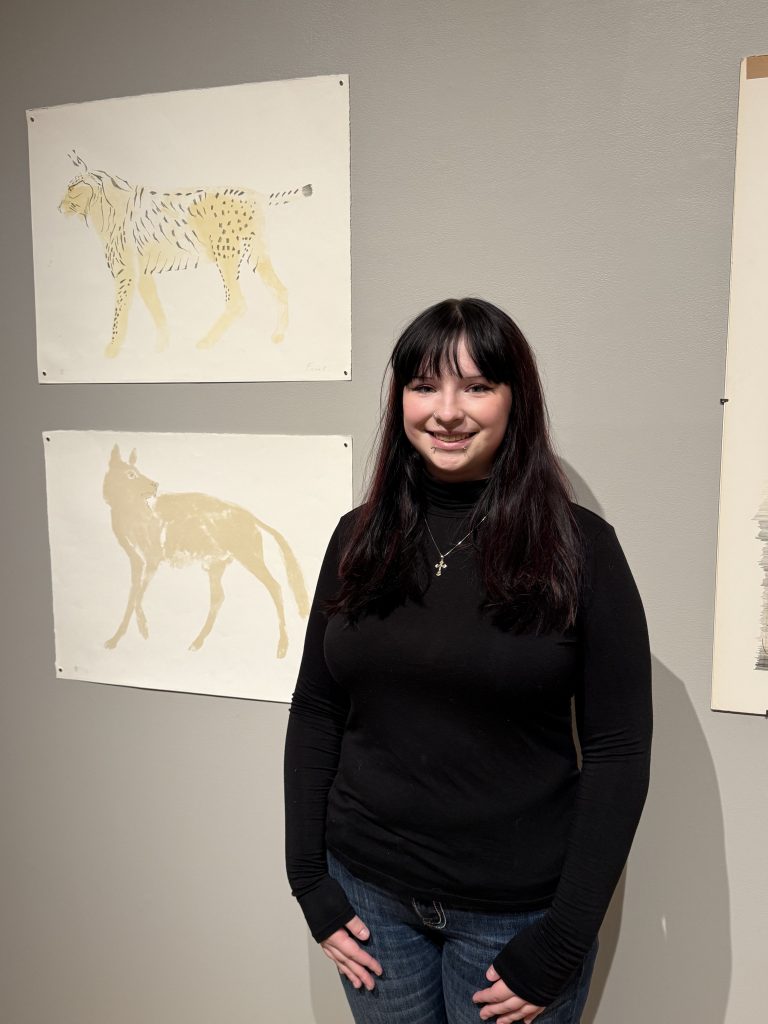
Riley Polomoscanik
Graduation Year: 2028
Major/Minor/Pathway: Art History and Biology double major with Chemistry minor
Favorite Color: Pink and Black
Favorite piece currently on view: Hooded Figures by Nicholas Monro
Something that surprised you about 1970: I was struck by how closely that period mirrors the social and political challenges we continue to face today. The parallels highlight how many of the same struggles, like power and identity, remain unresolved.
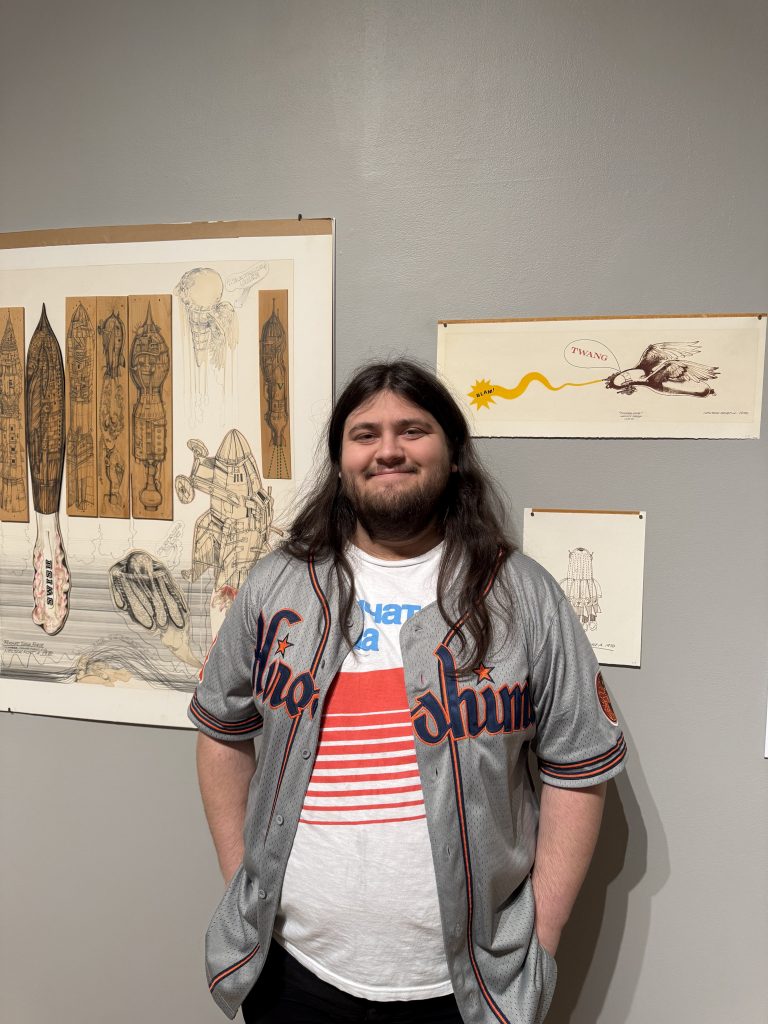
Jacob Sabes
Graduation Year: 2027
Books

Alvin Toffler, Future Shock (1970)
Future Shock is the classic that changed our view of tomorrow. Its startling insights into accelerating change led a president to ask his advisers for a special report, inspired composers to write symphonies and rock music, gave a powerful new concept to social science, and added a phrase to our language. Published in over fifty countries, Future Shock is the most important study of change and adaptation in our time.

David Brown, Fire and Rain: The Beatles, Simon and Garfunkel, James Taylor, CSNY, and the Lost Story of 1970 (2012)
Set against a backdrop of world-changing historical and political events, Fire and Rain tells the extraordinary story of one pivotal year in the lives and music of four legendary artists, and reveals how these artists and their songs both shaped and reflected their times.

Brian Vandemark, Kent State: An American Tragedy (2025)
Focusing on the thirteen victims of the Kent State shooting and a painstaking reconstruction of the days surrounding it, historian Brian VanDeMark draws on crucial new research and interviews–including, for the first time, the perspective of guardsmen who were there. The result is a complete reckoning with the tragedy that marked the end of the sixties.
Articles
Patricia McCormick, “The Girl in the Kent State Photo,” Washington Post, April 19, 2021
Online Resources
Mapping May 4 (website documenting Kent State shootings through mapping)
This exhibition was curated by College of Wooster students Jack Ferrell ’28, Roman Mackenzie ’28, Riley Polomoscanik ’28, Iris Roth-Bamberg ’26, and Jacob Sabes ’28, assisted by Marianne Eileen Wardle, Director/Curator. Many thanks to Doug McGlumphy, Preparator, for exhibition design and installation, and Tracy Mathys, Administrative Coordinator, for program support and design for promotional materials.
This exhibition and programs are made possible by the generous support of the Julia Shoolroy Halloran Fund.